What Is MRP? Meaning, How It Works, and MRP vs. Inventory Planning




Many wholesale distributors have invested in an ERP, CRM, e-commerce platform, and warehouse management system (WMS). Yet owning these tools does not guarantee that they work together.
According to the Distribution Strategy Group's State of Distributor Technology 2026 report, 55% of surveyed North American distributors had invested in core technologies but had not integrated them.
For HVAC, electrical, and building materials distributors, disconnected systems can create inventory discrepancies, outdated pricing information, delayed quotes, and repetitive administrative work. These problems reduce the value businesses get from their technology investments.
The challenge is not always a lack of software. It is whether your systems share the information your teams need to make accurate, timely decisions.
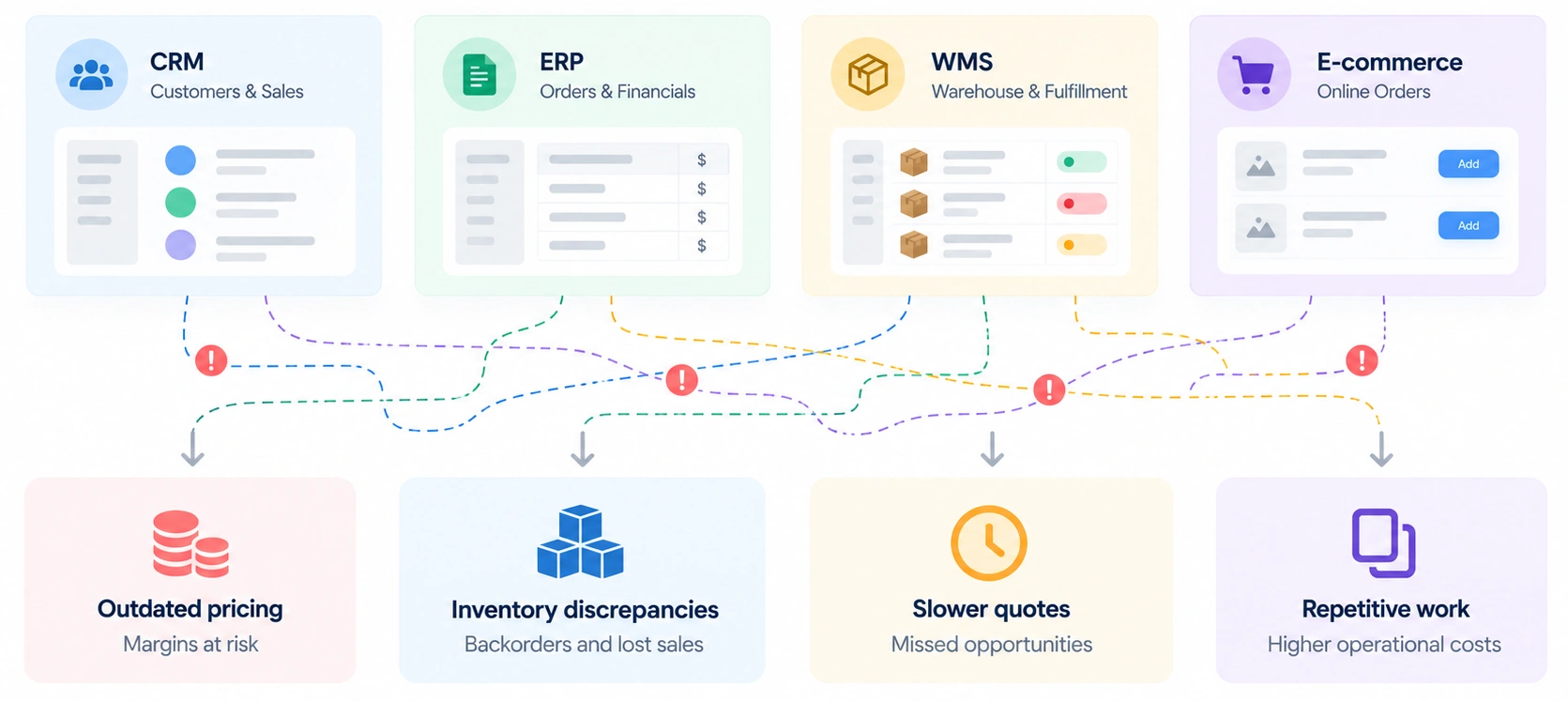
In a disconnected software environment, the CRM manages customer relationships, the ERP handles business transactions, and the WMS tracks warehouse activity. If these systems do not exchange information reliably, employees must bridge the gaps themselves.
A salesperson may check inventory in one application, verify customer pricing in another, and contact purchasing to confirm an incoming delivery. Employees may also export spreadsheets, re-enter data, and reconcile conflicting records.
These manual workarounds consume time and introduce opportunities for errors.
The DSG research highlights this integration gap as a major challenge for distributors. Its findings suggest that technology maturity depends not only on the tools a business adopts but also on how effectively those tools work together.
Electrical and other wholesale distributors often manage negotiated customer prices, supplier cost changes, and product-specific pricing rules.
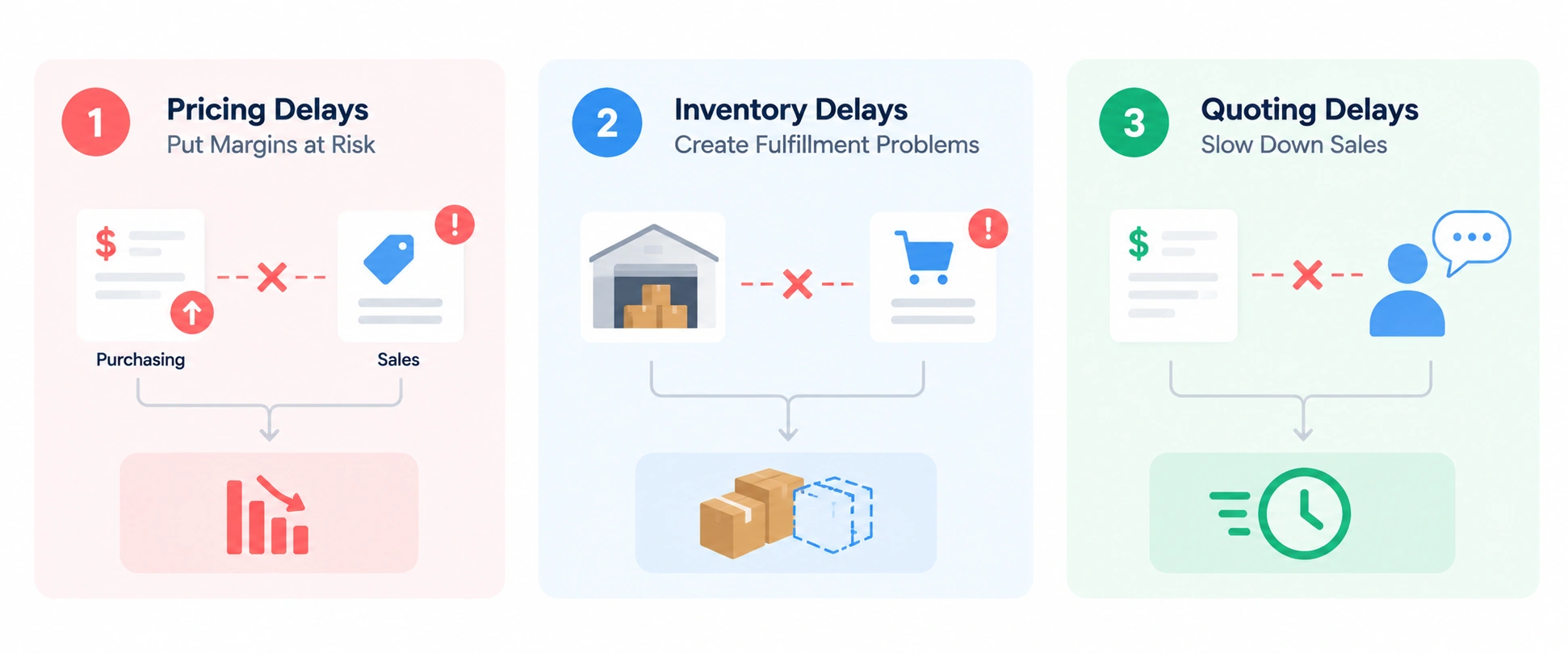
When purchasing costs and sales pricing are maintained in disconnected systems, salespeople may quote using outdated information. Even small pricing errors can affect profitability, particularly on high-volume orders.
What to improve: Connect relevant purchasing and pricing workflows, establish clear pricing controls, and ensure employees can access current, approved pricing information.
Explore VitalGap's electrical distribution solution for its distribution-focused pricing and operational capabilities.
If warehouse activity does not update inventory records promptly, salespeople may promise products that are no longer available. The result can be backorders, emergency transfers, additional shipping costs, and frustrated customers.
For HVAC distributors, seasonal demand makes inventory visibility especially important. Knowing what is available, what is committed, and what is arriving helps teams coordinate purchasing and customer orders.
What to improve: Maintain consistent inventory records across warehouse activity, sales orders, and purchasing. Track stock commitments and incoming inventory rather than relying solely on recorded on-hand quantities.
See our guide to HVAC procurement solutions for additional inventory and purchasing considerations.
In building materials distribution, a quote may depend on product availability, customer-specific pricing, credit terms, and project requirements.
When employees must check several systems before responding, the quoting process becomes slower and more difficult to manage. Repeated manual checks also reduce the time sales teams can spend serving customers.
What to improve: Give authorized sales employees access to the inventory, pricing, customer, and order information required to prepare accurate quotes.
VitalGap's hardware and building materials solution addresses distribution workflows involving project-based orders and material coordination.

Custom integrations can connect systems, but their effectiveness depends on how they are designed, maintained, and monitored.
Poorly managed integrations may fail when data formats change, software is updated, or synchronization errors go unnoticed. Multiple point-to-point connections can also make troubleshooting more complicated as the technology stack grows.
An API-first architecture provides a structured way for applications to exchange data and support custom workflows. However, APIs alone do not guarantee reliable integration. Data quality, error handling, synchronization rules, security, and system ownership still matter.
Read Why API-First ERP Matters for Wholesale Distributors to understand this approach in more detail.
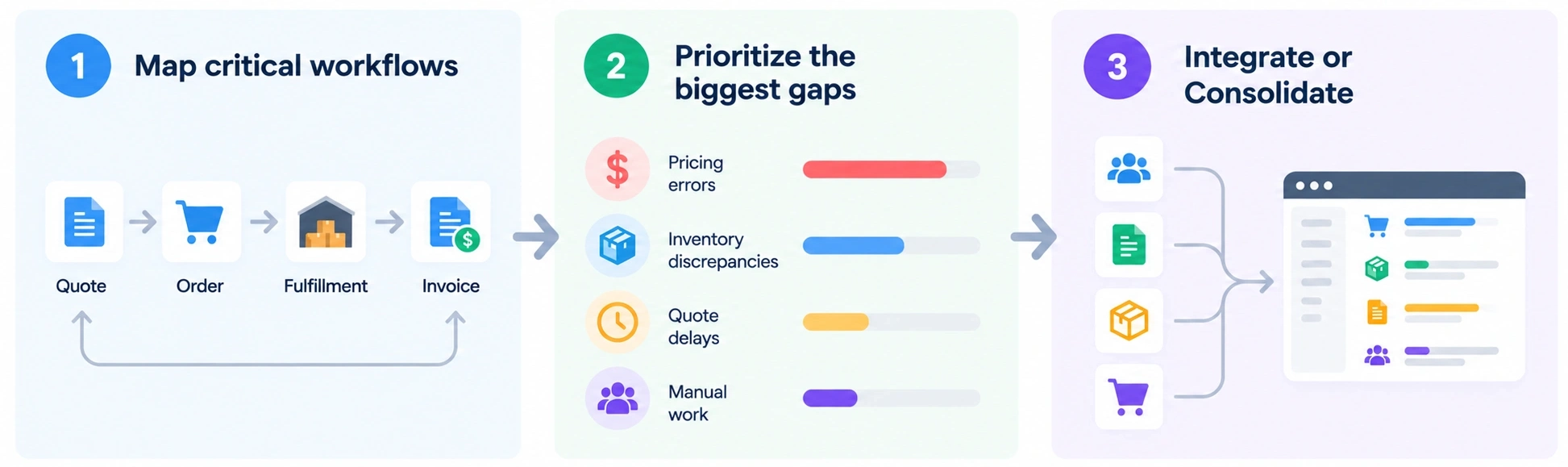
Before buying another application, identify where information breaks down between your existing systems.
Start with three practical steps:
Measure the results after implementation. Compare error rates, processing times, manual tasks, and operating costs against your baseline rather than assuming a new system will automatically deliver ROI.
The 2026 DSG research reinforces an important point: investing in technology is not the same as realizing its value. Disconnected systems can leave distributors paying for capabilities that employees cannot use effectively together.
The solution is not necessarily to replace every application. It is to create reliable workflows in which inventory, pricing, purchasing, and sales information remain consistent across the business.
VitalGap is designed for wholesale distribution, with published capabilities covering inventory visibility, complex pricing, job-based workflows, backorders, partial shipments, and API integrations. Its distribution-first platform is worth evaluating if disconnected processes are creating operational bottlenecks.
Ready to identify the gaps in your software stack? Schedule a demo with VitalGap to discuss your distribution workflows, integration requirements, and opportunities to improve operational visibility.


Whether you're looking to streamline operations, boost efficiency, or drive growth, VitalGap has the solutions you need.